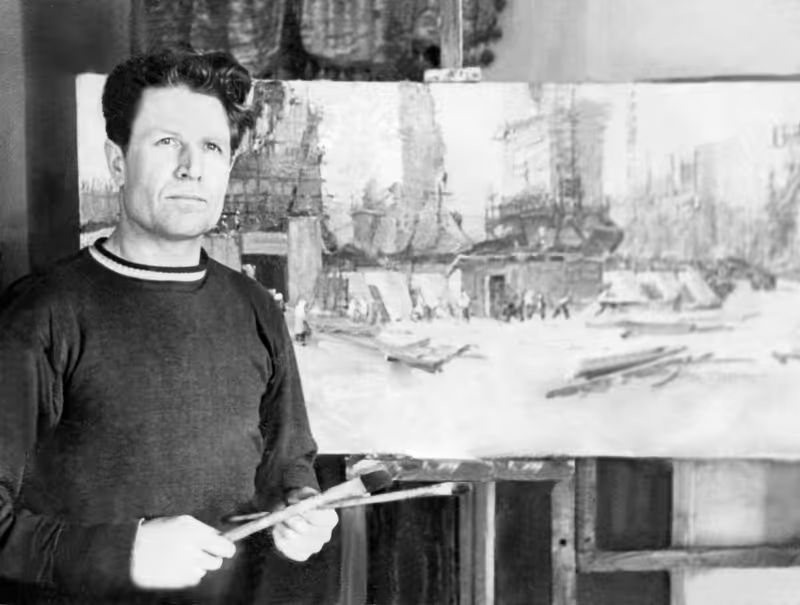
A Visual Biography
Petr Maltsev
In eighteen photographs and one life
1926 — 2010 · Chuhuiv · Slobozhanshchyna
Childhood and Famine
1926-1935
No photographs survive from this period.
Petr Nikolaevich Maltsev was born on 23 February 1926 in Maslovka, Chuhuiv district, Kharkiv region. The extended biography records that the village site became a military range in 1931, and family memory places the first displacement and famine years at the beginning of his life. The sources describe childhood through eviction, hunger, work, and survival.
In the 1999 interview Maltsev recalled that he began to draw in Bashkyrivka as a seven-year-old, asking soldiers for a pencil stub. This draft chapter treats art as something that began beside historical trauma, not apart from it.
“Perhaps this is where an artist is born: when he has lived through it himself, he has something to think about.”
Petr Maltsev, 1999 interview · 1999-09-18
War and Survival
1941-1950
The extended biography states that Maltsev met the Second World War in Bashkyrivka, near Chuhuiv, and entered the Red Army in July 1943. It records service on the 1st Ukrainian Front, participation in the fighting that led through Eastern Europe and Berlin, a wound, and later treatment in a military hospital.
The 1999 interview gives the historical outline a human register: hunger at the front, danger in Berlin, and a refusal to let memory end in despair. The provisional public text keeps the military facts close to the source and avoids expanding beyond what the family documents state.
“War must be remembered. It remembers itself, but one must look ahead to do something good.”
Petr Maltsev, 1999 interview · 1999-09-18
Returning to Art
1950-1968
After the army, Maltsev returned to Slobozhanshchyna. The extended biography records work at the Kharkiv art-products factory from 1950 to 1955 and study in an art studio with S. M. Besedin, E. N. Tregub, and V. M. Nasedkin. Later, while working in the Kharkiv Art Fund, he entered the Ukrainian Polygraphic Institute in Lviv and studied graphic art with Vasyl Kasiyan.
This chapter is framed as a disciplined return rather than a sudden beginning. The sources show a veteran entering professional art through work, study, craft, and persistence.
“My regiment commander even gave me a separate room: draw, Maltsev.”
Petr Maltsev, 1999 interview · 1999-09-18
The Repin Art School
1966-2005
In 1966 Maltsev became director of the Chuhuiv Children’s Art School named after Repin. The extended biography describes a school that had been close to closure and then grew to more than one hundred students each year, with student exhibitions shown across Kharkiv region and abroad.
The 1999 interview and later local text both treat the school as inseparable from Maltsev’s public life. For this draft, the school is not presented as a side role: it is one of the main works of his life, a place where teaching, local memory, and artistic discipline met.
“I have a school that is known far beyond Ukraine.”
Petr Maltsev, 1999 interview · 1999-09-18
Recognition Without Theatre
1970-2010
The sources record exhibitions, diplomas, public commissions, membership in the Union of Artists of Ukraine, the 2006 title of Honored Worker of Culture of Ukraine, and honorary citizenship of Chuhuiv and Chuhuiv district. They also preserve Maltsev’s own ambivalence toward official recognition.
This chapter keeps both lines visible: the public honors and the artist’s quieter measure of value. The 1999 interview suggests that the school, the students, and the survival of meaningful work mattered more than display.
“He never sought fame or high awards, but simply did the work he loved.”
Local commemorative text · 2010
Heritage
A legacy held between human, earth, and time
Three axes ran through everything he made. Each work in the archive sits at the intersection of two or three of them.
The face is the country. Family, neighbours, students, soldiers — the people of Slobozhanshchyna in their unsentimental dignity.
↗ My Contemporaries · 1980The chernozem — black earth — holds the memory of everyone who worked it. Roads, fields, the chalk hills above the Donets.
↗ Road to Kharkiv · 1965Slow light, long horizons. The painter as a witness to the seasons rather than a maker of events.
↗ Trees Die Standing · 1980